Assetization
Assetization is the opening up of the investment industry. As the infrastructure to create and service investment products becomes available to everyone, advisors and managers become creators, and almost any asset can be made investible.
There is a revolution happening in the investment industry.
For generations, investors have been confined to whatever products large institutions chose to put on the shelf. As a result, the majority of the world's wealth, hundreds of trillions of dollars in private equity, infrastructure, real estate and passion assets, has lain outside their reach.
Advisors and wealth managers have been stuck with a narrow toolset, unable to build truly custom solutions. As a result, however well they know their clients, their value has disappeared into someone else's brand, and their fees have become ever harder to justify.
Thanks to new technology and approaches, this is changing. The infrastructure of the investment industry is democratizing. The tools to create financial products are becoming ubiquitous. All assets are becoming investible.
We call this movement assetization: turning almost anything of value into a bankable, investible security. And it's so important we wrote a book about it.
On this page you can learn more about what assetization is, and why it matters.
Why assetization matters
Creating investment products has traditionally been a slow, expensive and very complex process. That's why today only a handful of large institutions create most of the supply. Assetization changes the equation.
Managers and advisors become creators
They can design and issue solutions that fit clients exactly, rather than forcing clients into pre-packaged molds. A manager can bring a strategy to market without launching a full fund.
Gatekeepers lose their lock
Once creating a product no longer requires a bank's balance sheet or a fund's scale, the small group that set the menu, the fees and the minimums loses control.
The investible universe widens
As the cost of creating a product falls toward zero, more of the world's value can be made investible. Investors are no longer limited to what happens to be on the shelf.
How wealth and asset managers benefit
If you are an asset manager, a family office, a smaller bank or anyone else who puts investment products in front of clients, assetization will radically improve the toolkit you have at your disposal. This in turn can help your business.
Build for the client in front of you
Instead of finding the closest thing on someone else's shelf.
Put your own name on the product
Right now the brand value goes to the fund manufacturer, even when the thinking was yours.
Charge for work that is actually yours
You cannot win a price war against a platform selling ETFs at near zero. You do not have to fight one.
Say yes
When several clients get interested in the same thing, you can build something for it rather than explaining that nothing on the shelf fits.
Keep the assets
Recommend an external fund and the money leaves your orbit. Create the product and it stays connected to you.
The three waves of assetization
Assetization is already happening. We see it around us every day, from the ETF revolution to the democratization of private markets to companies like ours rethinking the securitization process. As we write in our book, we see this revolution happening in three overlapping phases.
The democratization of access
The exchange-traded fund moved decision-making from the product issuer to the investor. A sellers' market, where a few institutions set the menu, became a buyers' market. But investors still depend on institutions to create the products in the first place.
The containerization of finance
Securitization and tokenization are to finance what the shipping container was to trade: standard containers that carry almost any exposure through the existing system. When product creation becomes modular, the capability moves out of institutional factories and into the hands of advisors and managers. Curators become creators.
Radical automation
As artificial intelligence takes over structuring, documentation and issuance, the path from idea to live product collapses toward minutes and the cost of creation approaches zero. The line between those who use products and those who make them disappears.
The containerization of finance
In 1956 a trucking entrepreneur called Malcolm McLean loaded 58 standardized containers onto an old tanker in New Jersey and changed the world. Thanks to containerization, the standardization of shipping, the cost of loading a ton of cargo fell by around 97%, from $5.86 to 16 cents per ton (Marc Levinson, The Box).
We like to compare assetization to containerization, because we think something similar is happening in the investment industry as we standardize, modularize and ultimately automate the infrastructure.
Where does GenTwo fit in?
The investment value chain has a lot of moving parts. At GenTwo, we work on one part of it: product creation. But if you look around, you can see that the whole chain is opening up, democratizing. That's where the power of assetization will come from.
Product creation
Modular services replace the institution's own factory
Distribution
Open platforms replace proprietary shelves
Custody and servicing
The back office, available "as a service"
Trading venues
Standardized listing and settlement for private assets
Valuation and data
Certified valuations make more assets analyzable
Lifecycle and compliance
KYC, AML and reporting, automated
Untapped assets: the trillion dollar opportunity
Public markets are only a slice of the real economy. Global equities are worth around $125 trillion and bonds around $145 trillion, yet US listed companies have roughly halved, from nearly 8,000 in the late 1990s to fewer than 4,300, while about 80 percent of US companies with revenue above $100 million remain private. Most value now sits outside the exchanges, and very little of it is accessible today.
| Asset class | Estimated size | Accessible or wrapped today | Source |
|---|---|---|---|
| Real estate | ~$393 trillion (2024) | ~$6 trillion financialized, about 1.5% | Savills |
| Private equity | ~$60 trillion across ~935,000 companies | More than 10x global PE fund AuM | SIPA / EDHEC |
| Private credit | Over $30 trillion addressable (US) | Expanding as banks retreat under Basel III and IV | McKinsey |
| Infrastructure | ~$15 trillion shortfall to 2040 | Shifting from public funding to private capital | Global Infrastructure Hub (G20) |
| Passion assets | Over $2 trillion (art and collectibles) | Largely illiquid, opaque and unwrapped | Deloitte |
| Digital assets | ~$3 to $4 trillion | Only ~$200 billion wrapped, about 1% | Oliver Wyman |
Beyond these sit the frontier assets, small today but a signal of how far the definition of an asset now stretches: music-royalty securities issued over $8 billion from 2020 to 2024, the prediction platform Polymarket processed over $9 billion of volume in 2024, and global sports betting passed $100 billion. Money is already moving: institutions allocate up to a third of portfolios to private markets, and US retail private-capital holdings are forecast to approach $2.5 trillion by 2030. Demand is not in question. Access is the constraint assetization removes.
Go deeper
Read the book
Assetization: Inside the Trillion-Dollar Investing Revolution
Now in its second edition, published with Wiley, written by the team at GenTwo who coined the term and built the securitization-as-a-service infrastructure beneath the category. Since 2018, GenTwo has assetized more than $8 billion across 1,750+ products for 300+ clients in 30 countries. We define the category because we built the rails beneath it.
Get the book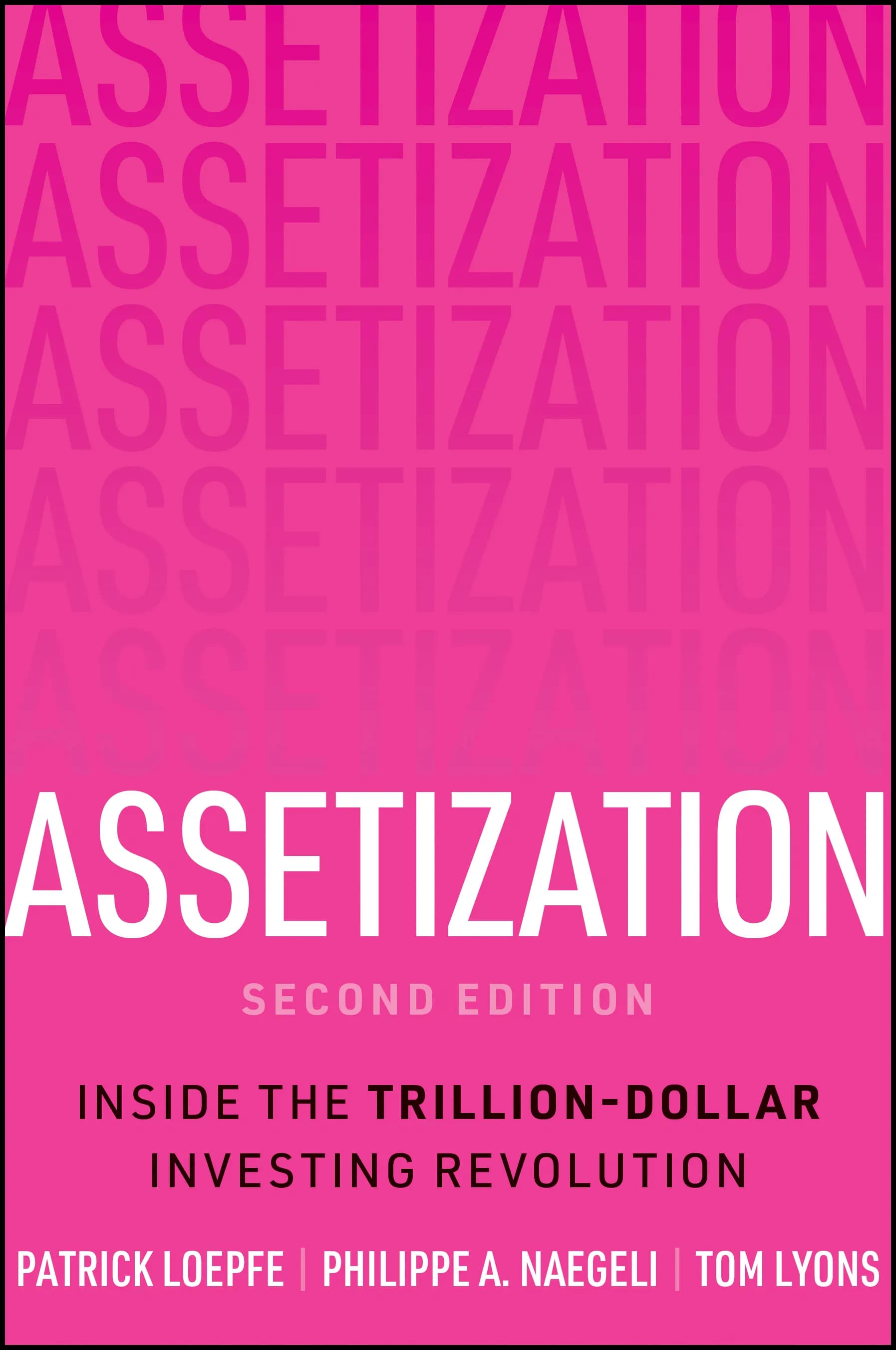

Turn a strategy into a bankable instrument.
GenTwo is the securitization infrastructure behind assetized products issued in Switzerland and beyond. If you're ready, the next step is a conversation.