The Assetizer · 10 April 2024
Fintech Exists to Make Things Easier for People
Pete Casella is a prominent figure in the US venture capital space, and led fintech investment for Point72 Ventures. We talked to him about the role of fintech in financial services and his vision for Assetization.DOWNLOAD The Interview with Pete Casella
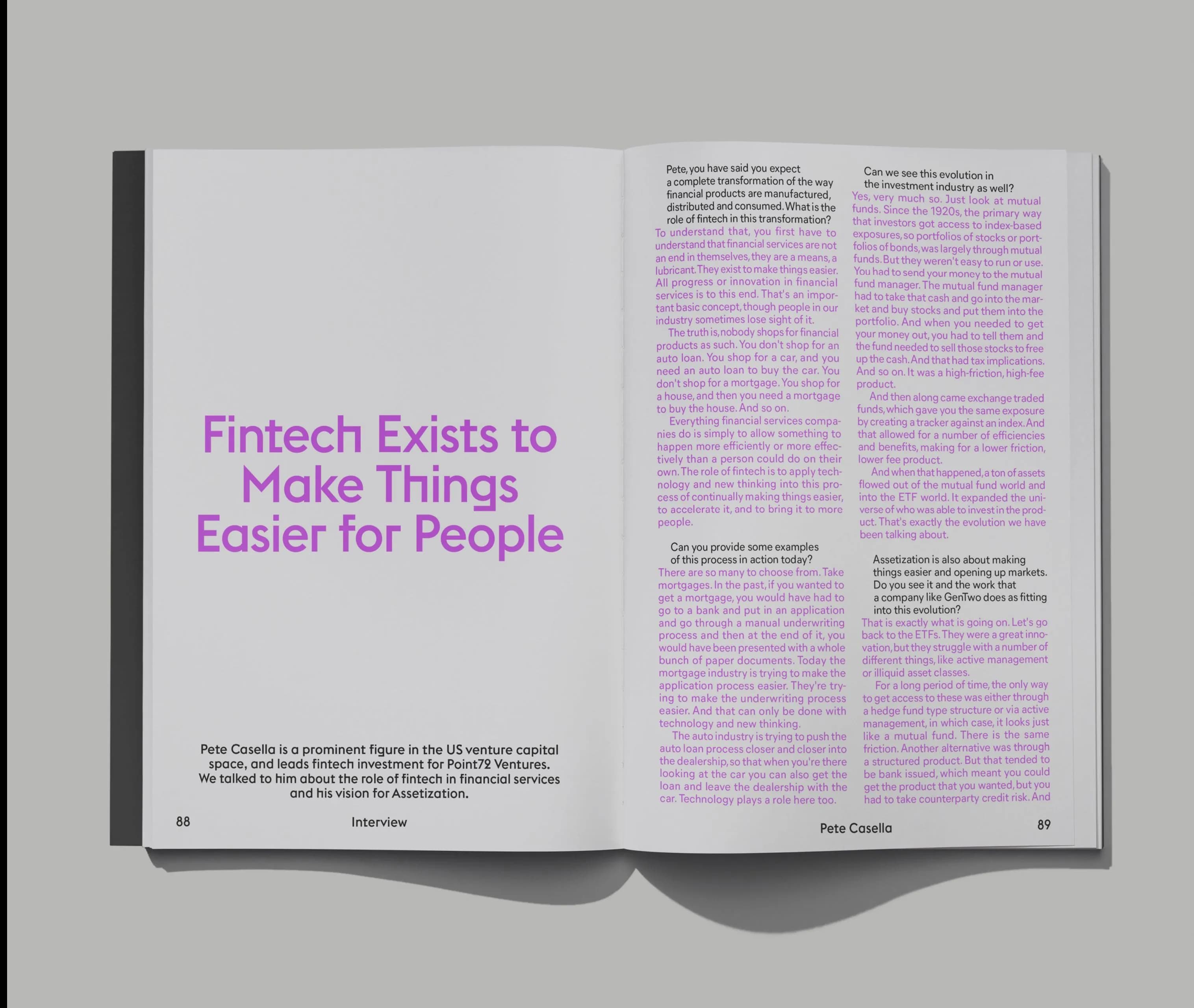
Pete, you have said you expect a complete transformation of the way financial products are manufactured, distributed and consumed. What is the role of fintech in this transformation?
To understand that, you first have to understand that financial services are not an end in themselves, they are a means, a lubricant. They exist to make things easier. All progress or innovation in financial services is to this end. That's an important basic concept, though people in our industry sometimes lose sight of it.
The truth is, nobody shops for financial products as such. You don't shop for an auto loan. You shop for a car, and you need an auto loan to buy the car. You don't shop for a mortgage. You shop for a house, and then you need a mortgage to buy the house. And so on.
Everything financial services companies do is simply to allow something to happen more e!iciently or more e!ectively than a person could do on their own. The role of fintech is to apply technology and new thinking into this process of continually making things easier, to accelerate it, and to bring it to more people.
Can you provide some examples of this process in action today?
There are so many to choose from. Take mortgages. In the past, if you wanted to get a mortgage, you would have had to go to a bank and put in an application and go through a manual underwriting process and then at the end of it, you would have been presented with a whole bunch of paper documents. Today the mortgage industry is trying to make the application process easier. They're trying to make the underwriting process easier. And that can only be done with technology and new thinking.
The auto industry is trying to push the auto loan process closer and closer into the dealership, so that when you're there looking at the car you can also get the loan and leave the dealership with the car. Technology plays a role here too.
Can we see this evolution in the investment industry as well?
Yes, very much so. Just look at mutual funds. Since the 1920s, the primary way that investors got access to index-based exposures, so portfolios of stocks or portfolios of bonds, was largely through mutual funds. But they weren't easy to run or use. You had to send your money to the mutual fund manager. The mutual fund manager had to take that cash and go into the market and buy stocks and put them into the portfolio. And when you needed to get your money out, you had to tell them and the fund needed to sell those stocks to free up the cash. And that had tax implications. And so on. It was a high-friction, high-fee product.
And then along came exchange traded funds, which gave you the same exposure by creating a tracker against an index. And that allowed for a number of eddiciencies and benefits, making for a lower friction, lower fee product.
And when that happened, a ton of assets flowed out of the mutual fund world and into the ETF world. It expanded the universe of who was able to invest in the product. That's exactly the evolution we have been talking about.
Assetization is also about making things easier and opening up markets. Do you see it and the work that a company like GenTwo does as fitting into this evolution?
That is exactly what is going on. Let's go back to the ETFs. They were a great innovation, but they struggle with a number of di!erent things, like active management or illiquid asset classes.
For a long period of time, the only way to get access to these was either through a hedge fund type structure or via active management, in which case, it looks just like a mutual fund. There is the same friction. Another alternative was through a structured product. But that tended to be bank issued, which meant you could get the product that you wanted, but you had to take counterparty credit risk. And we saw what happened for example with Credit Suisse and in many other cases recently.
The end effect is that the only people that have been investing in alternative asset classes are ultra-high-net-worth individuals, qualified investors, institutions or people who understand counterparty credit risk.
What I believe Assetization is all about, and what companies like GenTwo are solving, is the ability to provide that exposure without the counterparty credit risk of a banking institution. It's a vehicle that allows you to have exposure to esoteric, innovative, long-short, multi-asset class, illiquid type strategies in the same way that a hedge fund might, but without the hedge fund.
GenTwo is a perfect example of how technology and new thinking opens things up. It allows people to get involved in the industry that weren't involved in the past. It allows asset managers to o!er these types of products to customers that were historically unable to access them. And because it's technology enabled, it reduces the overall operating cost to launch a product, which should produce downward pressure on fees over the long term. That's really Assetization in a nutshell.
What does this look like in future from the investor's perspective?
No two investors are created equal. You and I may be substantially similar in terms of our age and our risk tolerance and our investable assets, but my portfolio should be a reflection of my beliefs. Obviously there's some rules in there, of course. Like you should make sure you're abiding by some portfolio best practices around diversification and risk and things like that. But generally the things that I believe in are very unique to me. And my guess is if you were to look at every person in the world that has money to invest, if you were to really give them all the tools to express their viewpoints, there will be slight differences between every single person. What investors want, and what Assestization gives them, is the ability to invest in their beliefs, whatever they are.
Yet historically, based on the products that were available to invest in or that were easily accessible, people were constrained. It has not really been possible to express investment views in a truly personalized way.
Only in a world where all asset classes and sub-asset classes are accessible in an easy way can you see a movement towards true investment personalization.
And from the asset manager's perspective?
The precondition for investors being able to invest in anything that they believe in is that asset managers have the ability to create the products that they believe investors want. And if today they're constrained by their own balance sheet or their own credit rating or their own distribution channels, it's going to stifle the true creativity and product development that would satisfy investor interest. And so I think creating tools that allow investors to express their views ultimately opens up the ability for the end investor to invest in the things that express their views.
We're not at the stage yet where the end investors have true democratization. In order for that to happen, you need to assetize every asset class. Which means that professional investment managers need to identify all of the hardest to access asset classes and strategies and they need to find all the di!icult things to do and use this product innovation to then do them and make them available to end investors who don't even know they need it yet.
You said adding efficiencies and access always increases market size. To what extent do you think Assetization will increase the size of the investment universe?
It's mostly an access problem today. For the largest liquid asset classes like US stocks, there are a plethora of ways an investor can get access. They can buy stocks through any number of brokers (bank owned, independent, digital), through advisors, through mutual funds, ETFs, etc. As the asset class becomes less liquid, or more speculative, the range of access vehicles decreases as does your ability to actually get access to the vehicles. Think about fine art, that's the domain of art collectors. Unless you have significant capital and know exactly how to find masterworks, that's just not available to you. Or investing in private companies through a venture capital round. The only investors coming into a VC round are funds that are hand-selected by management. Very few are chosen, and most of these funds are only accessible to large institutional investors or people who have direct relationships with the management teams of the funds. These are massive asset classes with unique risk return characteristics but the vast majority of investors do not have any of this exposure in their portfolios. As Assetization enables more of these categories to become investible, they will become more accessible to a wider range of investors, and allocations will follow growing the overall capital coming from new funding sources.
Do you think Assetization could lead to the creation of hitherto unknown asset classes or investment opportunities?
It's only a natural outcome. Once a technical innovation unlocks creativity, innovators will find ways to use it that were not even considered in the past. The iPhone paved the way for the AppStore, which enabled developers to build mobile applications. That spawned a vast ecosystem of new business models and industries that you couldn't have imagined when you first saw a touch screen phone that had the internet. At first with Assetization, the innovation will be obvious to the end user. It will be products that they know exist elsewhere but have just never been given the chance to access. But as innovators learn how to use financial technology to build new things, and they see that it is economically attractive to build things that people will buy, they will start experimenting. And those experiments will lead to a lot of flops, but will also lead to things that nobody had ever considered. And the entire nature of investing will change as a result.