The Assetizer · 27 February 2025
How to Securitize Everything – And Why You'd Want To
Democratizing finance will require making it much easier to create investment products for all types of assets. That means rethinking the securitization process from the bottom up.

This article first appeared in The Assetizer, GenTwo's newsletter and podcast platform.
Financial product creation remains stubbornly resistant to the democratization that has transformed other aspects of finance. A more efficient approach to securitization—standardizing wrappers and processes through digital platforms—could change this. This piece examines how such standardization might expand the investment universe while reducing friction for asset managers and investors alike.
This past Tuesday we published a podcast interview with Anastasia Bondareva, the Head of Structuring at GenTwo.
We talked in-depth about how product creation works at the company, how her team goes about turning any asset or investment idea into a bankable security, and what people are doing with this capability.
This got me thinking about the bigger picture of the mechanics of Assetization and the overall GenTwo approach. It is something we wrote about in detail in our book last year (most of that discussion is in Chapter 3 and Chapter 1, both available online).
In this post I would like to recap that story, because I think it’s instructive of many of the things we’re covering at The Assetizer.
Here is the podcast if you haven’t seen it yet.
Frustration, the Mother of Invention
When GenTwo's founders, Patrick and Philippe, started the company, they were motivated by a simple observation: asset managers and investors were increasingly frustrated with the limitations of traditional investment options and the constraints of the banking system.
There were limits on the kinds of products available, limits to accessing interesting opportunities, and limits to the imagination of many financial services providers. There was an overly constrained view of what types of things could be considered assets, and where potential value might be hiding.
To fix this, they set out to find better, more flexible ways of creating financial products. That in turn meant disrupting and removing cost and friction from the securitization process.
There was precedent for what they were doing. The history of financial services, from early stock exchanges to today’s e-banking and robo-advisors, has been a history of increased access and increased ease of use.
Financial engineering and technology have always played a crucial role in that. As Pete Casella told me last year, fintechs exist to reduce friction and make things easier for people.
The challenge in this case was to figure out how best to do it.
One Size Fits All
As with so much in tech, the solution lay in standardization and platformization. In GenTwo’s case, that came down to three main ingredients.
Standardized “wrappers” for assets. To gain efficiencies and make it easier to package any and everything you need standardized outputs. In this case, standard securities “that could act as a container for any kind of asset”. Actively Managed Certificates (AMCs) work very well for this (which is why we will be talking about them a lot in future posts). But other instruments like credit-linked notes, trackers and even tokens do the job too depending on the circumstance.
A digital platform. To reduce friction and increase flexibility, you need to take the process out of the hands of expensive specialists and put it in the hands of the actual product creators. In GenTwo’s case, the founders “broke down the securitization value chain into its component parts and modularized it and then built a digital platform around that to allow clients to directly access and steer the securitization process.” This was the genesis of the GenTwo Pro platform.
An open architecture. Finally, to address the “vendor lock-in” problem that can occur when securitizing via a bank or specialist, you have to make the platform as open as possible. This takes two main forms in the GenTwo approach. One is giving product creators the ability to set up their own issuers, or as the founders write, “to allow our clients to issue these products directly themselves if they wished, and not via a bank.” The other was to provide clients a choice of counterparties they want to work with, instead of being bound to those of the provider. GenTwo Pro delivers on this too.
Standard Power
As we all know, standardization and platformization are powerful tools.
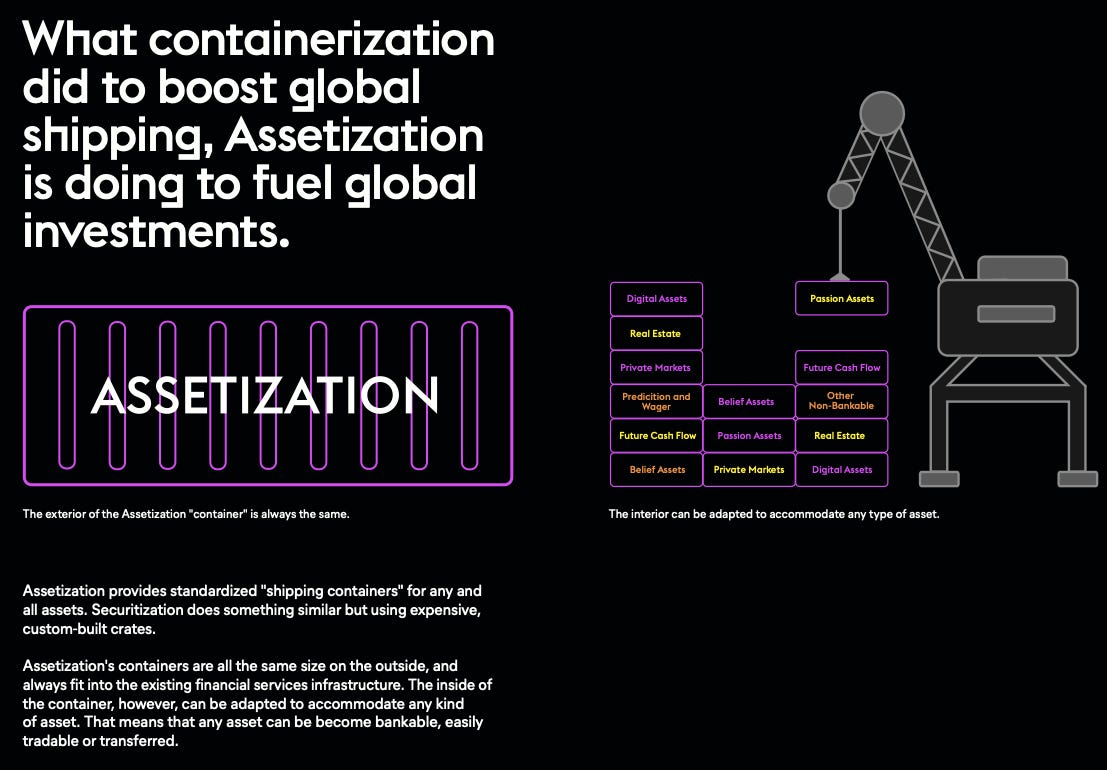
Our favorite analogy is with the shipping container. Just as containerization revolutionized global trade by making it possible to efficiently transport almost anything anywhere, Assetization make it possible to invest in almost anything through existing banking channels.
Standardization is also a key to innovation. When you provide a standard framework that handles the complex infrastructure parts, you free people to focus on what goes inside. History shows us that when barriers to creation come down, innovation accelerates dramatically. Financial product creation is poised for exactly this kind of transformation.
The decoupling from bank providers provides other benefits too. For example, the products created with GenTwo Pro are off-balance sheet and fully asset-backed. The assets themselves are held directly by the issuer (an independent company) rather than a bank, and so are not subject to bank counterparty risk. This clean separation increases security while maintaining all the convenience of a standard security. We’ll get into this in further posts as well.
Expanding the Investment Universe
Finally, to answer our second question, why would you want to do this, here are some thoughts:
First, it dramatically expands the investment universe. Assets that were previously inaccessible - fine art, private equity, exotic commodities, even intellectual property rights - can much more easily be made investible through normal banking channels.
Second, it democratizes access. Creating financial products becomes economically viable for both small and large assets, opening opportunities that were once reserved for institutional investors or the ultra-wealthy to a much broader audience.
Third, it's a catalyst for product innovation. Asset managers of all sizes can create new types of products without being constrained by what banks are willing to offer. They can respond more quickly to client requests and deliver truly personalized solutions.
Perhaps most importantly, it lets people invest in what they actually believe in, not just what’s on offer.
Those are some compelling reasons.
Tom Lyons
Head of Content, GenTwo