The Assetizer · 22 March 2024
"Power to the People - The History of the Democratization of Financial Services" – Free download of Chapter 4 of Assetization
Chapter 4, penned by Patrick Loepfe and Philippe A. Naegeli, delves into the historical journey towards financial inclusivity, illustrating how 'Assetization' is the next pivotal leap in the democratization of financial services.
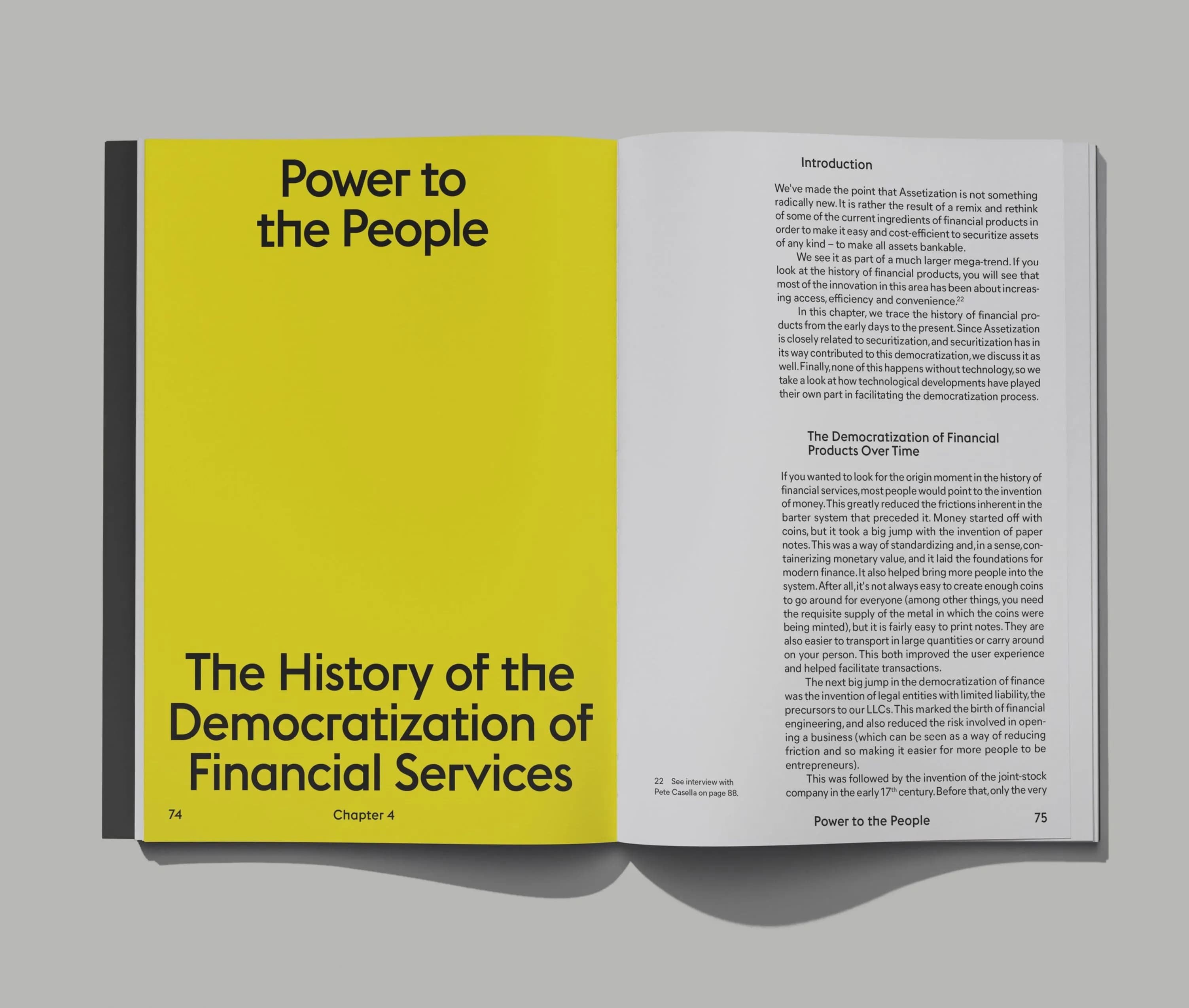
Chapter 4 takes us on a historical expedition through the evolution of financial products, highlighting the enduring trend towards democratization. From the genesis of the joint-stock company in the 17th century to the advent of modern retail e-brokerage, the narrative of financial services has been one of expanding accessibility and diminishing barriers. The chapter further explores how, since the 1970s, securitization began opening doors to alternative and previously non-bankable assets, albeit with limitations due to its complexity and cost. Enter Assetization, a concept that extends the democratization process by simplifying and broadening the scope of securitization to encompass virtually any asset. For more, you can download the full chapter as a PDF.
We've made the point that Assetization is not something radically new. It is rather the result of a remix and rethink of some of the current ingredients of financial products in order to make it easy and cost-efficient to securitize assets of any kind – to make all assets bankable.
We see it as part of a much larger mega-trend. If you look at the history of financial products, you will see that most of the innovation in this area has been about increasing access, efficiency and convenience.
In this chapter, we trace the history of financial products from the early days to the present. Since Assetization is closely related to securitization, and securitization has in its way contributed to this democratization, we discuss it as well. Finally, none of this happens without technology, so we take a look at how technological developments have played their own part in facilitating the democratization process.
The Democratization of Financial Products Over Time
If you wanted to look for the origin moment in the history of financial services, most people would point to the invention of money. This greatly reduced the frictions inherent in the barter system that preceded it. Money started off with coins, but it took a big jump with the invention of paper notes. This was a way of standardizing and, in a sense, containerizing monetary value, and it laid the foundations for modern finance. It also helped bring more people into the system. After all, it's not always easy to create enough coins to go around for everyone (among other things, you need the requisite supply of the metal in which the coins were being minted), but it is fairly easy to print notes. They are also easier to transport in large quantities or carry around on your person. This both improved the user experience and helped facilitate transactions.
The next big jump in the democratization of finance was the invention of legal entities with limited liability, the precursors to our LLCs. This marked the birth of financial engineering, and also reduced the risk involved in opening a business (which can be seen as a way of reducing friction and so making it easier for more people to be entrepreneurs).
This was followed by the invention of the joint-stock company in the early 17th century. Before that, only the very wealthy could invest in business or trade. Joint stock companies allowed capital to be pooled from many different investors. This democratized investment opportunities to a degree, enabling people from a wider range of backgrounds to participate in business and trade ventures that they would not have had access to before. It also made it possible for more types of people to raise capital and found businesses.
Another leap forward took place in the 19th century with the birth of formal stock exchanges like the New York Stock Exchange (NYSE), which played a crucial role in the evolution of financial markets. While this again expanded the number of people who had access to investment opportunities, access was still "gated": limited to those who could afford brokers. Still, this laid the groundwork for broader public participation in the financial markets in the years to come.
One of the most pivotal moments in the democratization of finance was the creation of mutual funds in the 1920s. These funds allowed people to pool assets which were then invested in portfolios managed by professionals and opened the gate for "regular people" to participate in the stock market.
The period following World War II saw a significant expansion in access to financial markets. The economic growth of this era, coupled with the emergence of retirement plans like 401(k)s and Individual Retirement Accounts (IRAs) in the United States, played a substantial role in this trend. These developments enabled a broader segment of the population, particularly in the United States, to invest in the stock market, further democratizing access to financial growth and wealth accumulation.
The rise of discount brokerage firms in the 1970s and 1980s marked another significant milestone in making financial markets more accessible. These firms disrupted the traditional brokerage model by offering lower trading costs. As a result it became more affordable for average individuals to buy and sell stocks, something that had previously been costly and exclusive.
The World Wide Web revolution of the 1990s transformed the financial world, with online trading platforms being a cornerstone of the transformation. These platforms made financial markets more accessible than ever before, allowing individual investors to execute trades, access market data, and perform research from their personal computers...